Atoll IN 200 Evolution – The Solid Heart of a Real-World System
Opening – Why this amplifier entered my system
On paper, my system should have been done.
At its heart was the NAD C399 — a modern all-in-one integrated with BluOS streaming, generous power ratings, and the promise of driving almost any speaker you could reasonably connect to it. A single box solution, tidy and rational, and in many ways very appealing.
In practice, it never fully clicked.
The speakers anchoring my system, the Focal Aria 948, are anything but polite. They’re large, revealing, and capable of real scale, but they also dip down to around 2.5 ohms in the impedance curve. That’s the kind of load that doesn’t just ask for watts on a spec sheet, but for genuine current delivery and control.
With the NAD C399 in place, the sound never fully opened up. The soundstage tended to stay confined between the speakers, instrument separation was serviceable but rarely convincing, and bass lacked the grip and authority these speakers are capable of. Nothing was obviously broken, but the system always felt slightly restrained.
Before blaming electronics, I worked on the room and the setup: speaker positioning, toe-in, spacing, a large carpet between speakers and listening position, and later a curtain to tame reflections. All of this helped — but it never ignited the spark.
Separating DAC and streamer from the NAD clarified part of the issue, but bass control and scale still didn’t fully materialize. That experiment didn’t solve the problem — but it clarified it.
What if the amplifier itself was the limiting factor?
That question is what led me to the Atoll IN 200 Evolution.
The product – a focused integrated amplifier by design
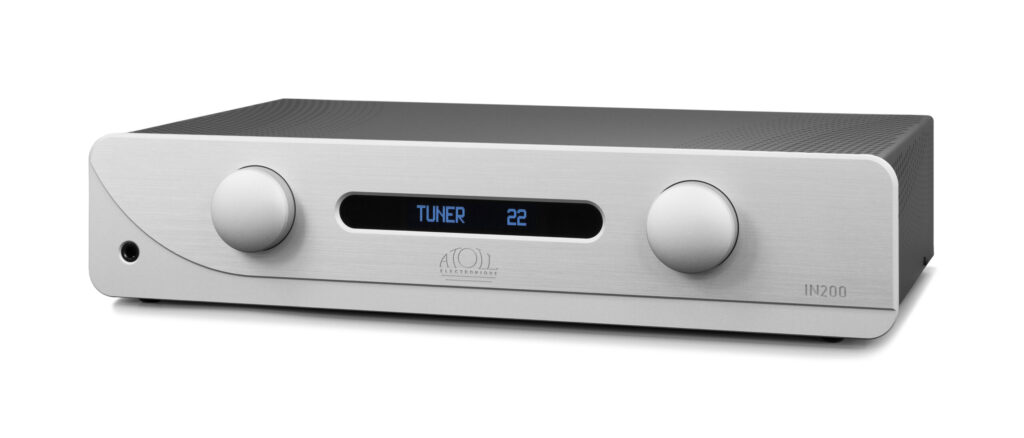
The Atoll IN 200 Evolution is a classic integrated amplifier in the best sense of the word. It doesn’t attempt to redefine the category, nor does it chase feature lists or trends. Instead, it refines a familiar concept: a solidly built, powerful, and flexible analog amplifier intended to serve as the long-term core of a serious two-channel system.
Visually, the IN 200 Evolution strikes a careful balance between understatement and presence. The design is clean, purposeful, and timeless, integrating naturally into a living space without demanding attention.
Conceptually, the amplifier is built around separation of responsibilities. Amplification is treated as its own task, not as one function among many. Digital features are optional rather than assumed, keeping the product focused and avoiding premature obsolescence.
The “Evolution” designation reflects refinement rather than reinvention — but the changes compared to the previous Signature generation are far from cosmetic. Atoll has reworked several key areas of the amplifier’s internal design with a clear focus on power delivery, channel separation, and noise reduction.
The power supply has been completely revised and now relies on multiple specialized transformers rather than a single shared unit. Combined with increased filter capacitance and a more clearly defined dual-mono architecture, this allows the amplification stages to operate with greater independence and stability, particularly under dynamic load.
Signal routing has been optimized to improve the signal-to-noise ratio and reduce crosstalk. High-quality, shielded MKP coupling capacitors are used throughout critical stages, alongside Mundorf components in key positions. These changes form the technical foundation for the Evolution line’s sonic refinements.
The Evolution models also employ a dual volume attenuation approach — one per channel — which improves channel separation and contributes to more stable and precise stereo imaging. Speaker binding posts made from tellurium copper, derived from the higher-end IN300, further underline the focus on signal integrity.
Beyond digital expansion via an optional internal DAC module, the IN 200 Evolution can also be fitted with an optional internal phono stage, allowing vinyl playback without external hardware. Despite its power and density, the amplifier remains surprisingly cool in operation, even during extended listening sessions.
It’s also worth noting that Atoll designs and manufactures its electronics in France. This isn’t presented as a marketing statement, but it shows in build consistency, long-term serviceability, and the availability of spare parts — qualities that align well with the amplifier’s intended role as a long-term system component.
Technical specifications (overview)
- Topology: Class A/B
- Power: 2 × 120 W (8 Ω), 2 × 200 W (4 Ω)
- Power supply: Linear, multiple transformers, increased filter capacitance
- Architecture: Advanced dual-mono layout
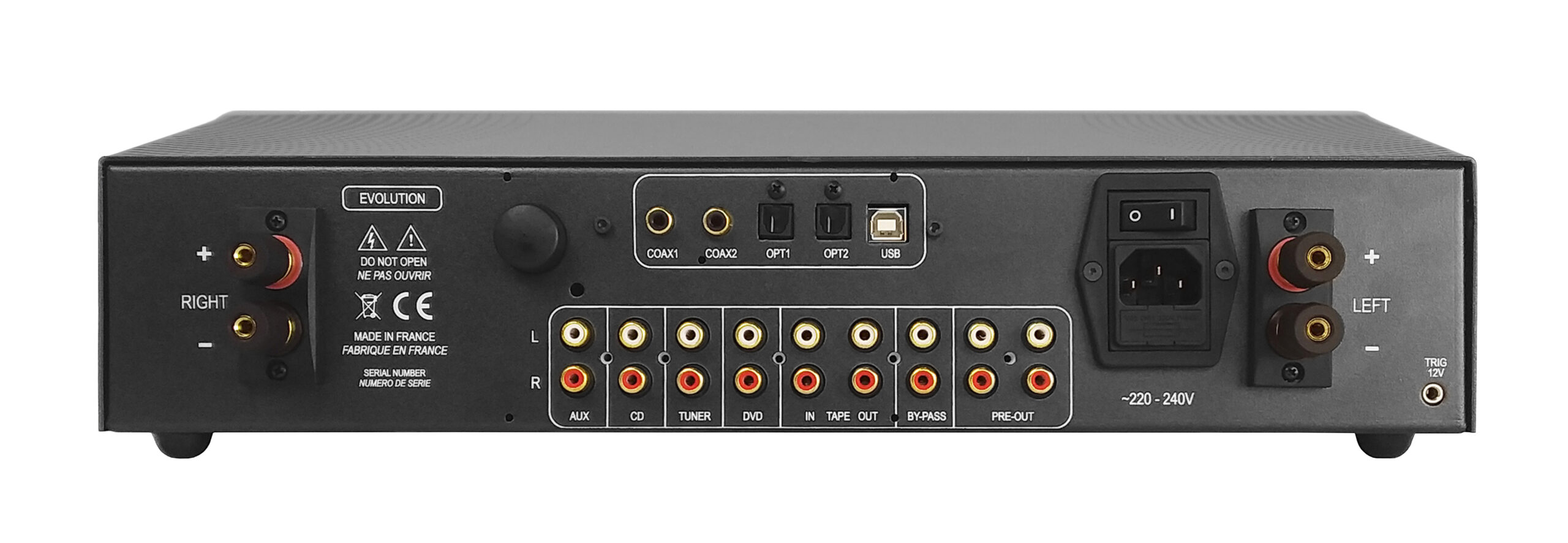
- Inputs: 5 × RCA line-level
- Outputs: 2 × pre-out, tape loop, trigger out
- Preamp bypass: Yes
- Expansion options: Optional internal DAC, optional internal phono stage
- Standby: Low-power standby
- Manufacturing: Designed and built in France
- Weight: approx. 12 kg
First impressions – weight, authority, and immediate clarity
The first impression came before a single note was played. Despite its slim appearance, the Atoll is heavy — dense in a way that immediately suggests serious power delivery.
Once powered up, the change was immediate: more authority, better separation, and a wider, more confident stage. The Focal Aria 948 finally sounded alive and composed. Despite that sense of power, the amplifier remained only mildly warm in operation.
The treble was better controlled without losing openness. I chose the version without the DAC board, committing fully to a separates approach — a decision that paid off from the very first evening.
Synergy – why this pairing works
This wasn’t just about power, but about control. The Atoll’s Class A/B design brought calm authority and grip, letting the Focals breathe. Bass lines became more defined, dynamics more relaxed, and the overall presentation gained confidence.
This is not an indictment of Class D in general, but the NAD C399 was simply not a good match here. Too many compromises in one box.
Volume rarely exceeds 25 out of 80 in my living room. Headroom is always present. Occasionally, I wonder if an IN 300 or IN 400 would go even further — which in itself says a lot about how revealing this pairing has been.
System evolution – why the Atoll stayed
At some point, a component stops being “under review” and simply becomes part of the system.
That happened quickly here. Listening sessions grew longer, the amplifier removed itself as a variable, and the system felt stable again.
The Atoll IN 200 Evolution stayed because it worked — quietly, consistently, and without drama.
Price / performance: At around €1,800, the Atoll IN 200 Evolution delivers comfortably above its price point.
Final thoughts
The Atoll IN 200 Evolution doesn’t chase trends or features. It focuses on the fundamentals: control, musical flow, and confidence. It may not be the final destination on my Listening Path — but it’s a trustworthy companion for a long stretch of the journey.
Key Strengths
- Clean, sleek design
- high build quality
- excellent binding posts
- satisfying volume control
- input naming
- flexible connectivity
- modular DAC and phono options
- cool operation
Considerations
- No dedicated subwoofer output
- no balanced XLR inputs
- average isolation feet
Technical Specifications
| Topology | Class A/B |
|---|---|
| Power | 2 × 120 W (8 Ω), 2 × 200 W (4 Ω) |
| Power supply | Linear, multiple transformers, increased filter capacitance |
| Architecture | Advanced dual-mono layout |
| Inputs | 5 × RCA line-level |
| Outputs | 2 × pre-out, tape loop, trigger out |
| Preamp bypass | Yes |
| Expansion options | Optional internal DAC, optional internal phono stage |
| Standby | Low-power standby |
| Manufacturing | Designed and built in France |
| Weight | approx. 12 kg |